Sightpsych - Home of OEI Observed Experiential Integration

Welcome to Sight Psychology!

The Home Of

OEI Observed & Experiential Integration


What’s in a name?

So why is this therapy called “Observed & Experiential Integration”?

Let’s examine each word in the name, from multiple perspectives…


OBSERVED

Other experiential therapies are cognitive. The client is asked to shift his or her thinking to “notice” thoughts, emotions, and physical sensations. This typically requires a shift from the midbrain to the medial prefrontal cortices, neuropsychologically.

In contrast, in OEI clients actually observe changes in co gnitions, emotions, and physical sensations, depending on which eye they cover. In that way, they cannot discount the duality of experience, and discover that one of the “observations” is a distortion. This leads to “mentalizing” (standing back and reflecting on the disparate experiences from a higher-order self). For clients with a great deal of emotional lability, this is an entirely new experience.

As clients continue to switch (alternately cover and uncover each eye), they usually observe integration (dissolving of distortion, accuracy of experience).


OBSERVED

Another reason that “Observed” is in the name of this therapy is that the therapist is constantly observing and noting tiny shifts in the facial expressions (emotional states), eye movements (halts, hesitations, skips) and body postures of clients. In response to these subtle changes, the therapist adjusts the pace and direction of what we call “switching”, “sweeping” and “glitch massaging”. The astute therapist is also maintaining attunement with the client, reflecting back what is seen in the client’s face (verbally), and mirroring (responding nonverbally) to these shifts.

A final reason the word “Observed” is in the name of this therapy pertains to what clients are doing. As therapy progresses, clients are asked to “Observe” their own perceptions, emotions, and body states. These reflections are primarily visual in nature (noting apparent proximity & appearance of the observed person) but also somatic & affective.

As clients continue to switch (alternately cover and uncover each eye), they usually observe integration (equalization of experience) with each eye open.


EXPERIENTIAL

The core purpose of experiential therapy, is to increase client awareness regarding human experience (in contrast to dissociation or non-aware existence). In humanistic-existential therapy (Bugental), clients are asked to recall events associated with deep emotions (fear, sadness, anger, and/or shame) and “stay with” (rather than dissociate from) those intense states until they achieve insight and the intensity dissipates.

In gestalt therapy (Perls), clients and therapists process “unfinished business” and reclaim disowned aspects of self. In the process, subtle intensity & conflict markers are observed and brought to awareness, with resulting insight.

In focusing (Gendlin), clients are urged to attend to subtle affective, somatic, perceptual, and cognitive states and notice subtle, almost imperceptible, changes.

In OEI (Cook & Bradshaw), clients attend to, and report on, both subtle and intense experiences they have in therapy (i.e., during application of the six OEI techniques: “switching”, “sweeping”, “tracking”, glitch massaging”, “glitch holding”, and “releasing”).


INTEGRATION

As OEI progresses, clients integrate dissociated traumatic material that was previously beyond their awareness. In addition, clients with dissociative disorders integrate alternate personalities (“alters”).

Many times during each session, client’s integrate (combine, equalize, or dissipate) disturbing emotions, cognitions, somatic sensations, and visual perceptions. As a result, they become less “stuck” and less “stirred up” (triggered) in their lives.

Some observers have said that OEI is like a combination of EMDR (Eye Movement Desensitization Reprocessing), Educational Kinesiology (‘Brain Gym’), and Gendlin’s Focusing. Others have noted a similarity to Dual Brain Psychology (Schiffer). It is important to recognize that OEI is none of these other therapies, but in fact has developed into an entirely new and different psychotherapy. Readers interested in how OEI differs from these other therapies are encouraged to send questions to This e-mail address is being protected from spambots. You need JavaScript enabled to view it


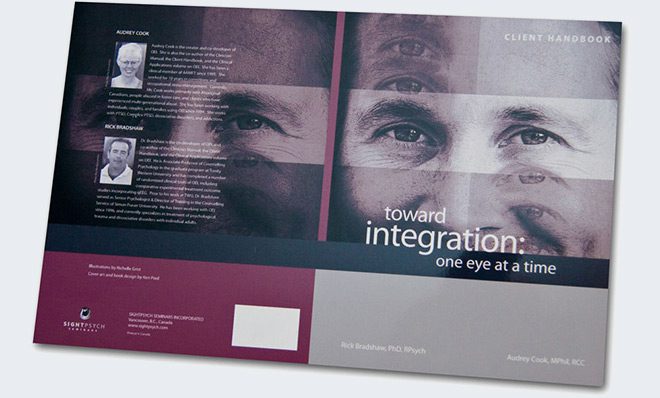
Audrey Cook

Audrey Cook

is a marriage and family therapist, with an academic background in Criminology.   Her interest was in sexual offences and deviance, stress management and burnout prevention.  She worked in Adult Education for Family Services in B.C. and for a number of local colleges.  For the past twenty years, she has worked in her therapy practice, which combines family work and intensive trauma work.  Her clients are typically Aboriginal Canadians and she works extensively with multigenerational trauma.

Dr. Bradshaw

Dr. Rick Bradshaw

received his Ph.D. from Michigan State University.  Until 1998 he had been employed for 10 years as the Senior Psychologist & Director of Training in the Counselling Service of Simon Fraser University.  He left SFU to work for three years as a consulting psychologist with Wilson Banwell Corporate Health Consultants.   He left to join the Counselling Psychology Department at Trinity Western University in Langley, B.C. as Associate Professor of Counselling Psychology where he teaches graduate studies and supervises research projects.

Practitioners Gateway

SightPsych Gateway

The gateway is the entrance for therapists who wish to access online OEI resources - including courses, downloads, audio, video, articles, etc.


**Registration is required in order to pay monthly dues or gain access to the directory.


Login